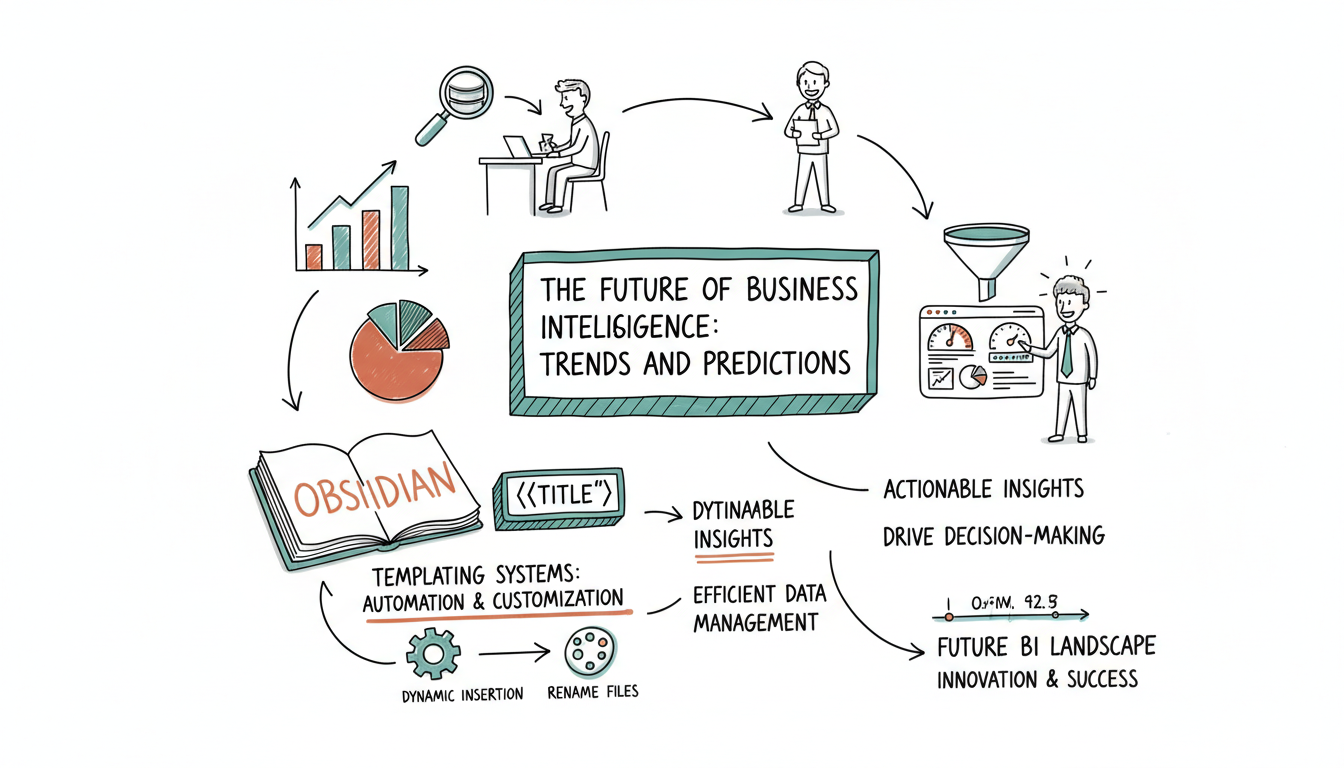
In the ever-evolving landscape of Business Intelligence (BI), staying ahead of the curve is crucial for data professionals, analysts, and business leaders. The future of Business Intelligence is not just about collecting data but transforming it into actionable insights that drive decision-making. In this blog post, we explore the latest trends and predictions shaping the BI industry, providing a roadmap for those eager to harness the power of data analytics and visualization.
One of the most exciting developments in the BI space is the integration of advanced templating systems, such as those seen in Obsidian workflows. Obsidian, a powerful note-taking application, utilizes templating placeholders like {{TITLE}} to streamline and automate the process of data entry and organization. This feature allows for dynamic insertion of filenames or note titles into templates, enhancing efficiency for users (source). By synchronizing filenames with the first heading, users can maintain consistency and accuracy in their data records, a feature that has become natively supported since Obsidian v0.16 (source).
The Templater plugin in Obsidian further enhances this capability by introducing conditional logic based on filename prefixes. This allows users to dynamically select templates, ensuring that the right structure is applied to each note. For instance, a filename starting with "@" might automatically load a template designed for personal contacts, while other prefixes trigger different templates (source). This level of customization is invaluable for BI professionals who need to manage diverse datasets efficiently.
Moreover, the ability to rename files from templates using prompts ensures that notes are never left untitled, reducing clutter and improving organization. This feature, coupled with the option to append dates to filenames, provides a robust system for tracking data over time (source). Such innovations in note-taking and data management tools highlight the growing importance of automation and customization in the BI industry.
Beyond Obsidian, the concept of templating extends into other areas, such as wiki and mediawiki syntax. Here, templates like {{title}} are used to format text and ensure consistency across pages (source). While these applications are more focused on content presentation, they underscore the broader trend of using templates to enhance data interaction and visualization.
As we look to the future, the integration of templating systems with BI platforms is set to revolutionize how data is processed and visualized. By automating routine tasks and providing customizable frameworks, these tools empower users to focus on deriving insights rather than managing data. This shift towards automation and efficiency is a key trend that will define the BI landscape in the coming years.
In conclusion, the future of Business Intelligence is bright, with templating systems like those in Obsidian leading the charge towards more efficient and effective data management. As BI professionals, data analysts, and business leaders, embracing these trends will be essential to staying competitive and making informed decisions. The ability to transform raw data into meaningful insights through advanced tools and techniques will continue to drive innovation and success in the industry.